Showing posts with label Freebies. Show all posts

Saturday, June 6, 2015

End of the Year...No Thank You

I kind of detest breaking down my classroom at the end of the year.  It's so anti-climatic. All that hard work by the students is taken down.  And all of the classroom decor that I painstakingly cut, laminate and hung with velcro/sticky tack/command strips just gets tossed or shoved into a box.  I usually retrain my focus on what I love and that is decorating all over again in a couple months time!

As I watched my news feed fill with teachers end of the year gifts, I was planning what I wanted to tweak this year.  I had these word wall headers I made a couple years ago when we first started the common core standards and there was more of a push on informational texts and topics.  I love these headers and their bright colors so I decided I wanted more of that.  I spend 7.5+ hours a day for 180+ days in the classroom so I just want to look around and feel happy.


My inspiration:  nonfiction alphabet headers

As I started making new things for the classroom I kept having more and more ideas.  So my tweaks turned into a 100+ page colorful classroom decor set!  This set is full of things that your students will use on a daily basis, such as, jobs, table numbers, number posters, ABC posters, word wall headers, word wall words, birthdays, schedule, hand signals, nameplates and more.  You can pick it up here: Colorful Classroom Decor 


I also made the ABC posters as a stand alone: Colorful Alphabet Posters


I also made Bohemian Classroom Decor based off this digital paper that has feathers on it which I L.O.V.E!  
Aren't the feathers lovely?


Now what would a post be without a freebie?!  Today I have essential items for your classroom door!  These are my must haves and I hope you enjoy them.  Pick it up here:  Door Decor

Sight word slap is a great way for students to learn sight words in a fun way.  Just print, laminate and write a new word with dry erase marker daily.  Students will high five the word and say it aloud.

Math Password is a fantastic way to give your students more practice. Again print, laminate and write a new math problem every day.  As the students pass, they will whisper the answer.  This is a great way to spiral or practice the tricky bits.  *Tip: Any child that answers incorrectly I send to the back of the line to think.  If they still don't get it right on the second try, I quietly reteach several students, model the problem, or give them a strategy.

Welcome to pennant is just a bright, colorful, space saving way to add a little cheer to your door.  I made it and intend to punch holes on the sides and thread through ribbon.


So are you planning for the new school year or actually taking time to enjoy summer?

I


Thursday, February 5, 2015

Once Upon a Time...

For the past two weeks we have been investigating Fairy Tales, Folk Tales and Fables.  I have always loved these stories but I think my students love them even more!

This unit is covering many of the literature standards, which is great.   Even better is the engagement from the students.  It's one of the best feelings as a teacher when you hear, "When will reading begin?"  "I can't wait for our lesson today!"  "Did you know she's reading ___ to us today?!"

We started out by reading a fairy tale and looking at the elements that made it so.  Then on to folktales and finally fables. (I blew their minds when I told them fairy tales really are folk tales!)


Then we started reading versions of The Three Little Pigs.  Story elements, comparing/contrasting, and character responses were pulled in all week and it was seamless.


On to week two!  We are reading different versions of Cinderella.  There are so many but we are really enjoying our choices.  The standard that is taking the main stage is comparing and contrasting.  I found that students stayed at the surface level during the first week and didn't push their thinking very deep.


We are also using theme to compare and as a class we decided that from person to person theme might be differences because we all think differently.  As long as you can share your thinking and provide text evidence (and talk to it) then we are good!


After a week in reading, we started to look at the genre in writing.  Our anchor chart transferred from the reading section of the board to the writing section.  The nerdy teacher that I am gets really excited when the students realize that the work you do as a reader helps you as a writer...or vice versa, the work you do as a writer helps you as a reader.


The first day planning, I realized that this will be there FAVORITE unit in writing.Their planning conversations were filled with high pitch, fast talking!


Now they are drafting and when they finish their fairy tale we will move on to fables.


Next week, we are going to use fables in reading to help us with central message.  In writing, we will be planning and drafting fables.  The first thing we will plan is the moral of the story then we will move on from there.


Today I have a reading and/or writing freebie for you.  You can use these graphic organizers as a response to reading or use them to plan writing.


Saturday, January 10, 2015

Dollar Tree Ideas #1

We all know that teachers are cheap....we have to be!  Today I was at the Dollar Tree and I bought a couple things for my math centers.


First up is Calendar Addition.  I purchased a calendar from the Dollar Tree and wrote numbers on each day.  The idea is to add numbers in the calendar.  What's great about this center is that it is differentiated.  So it can be used for various levels within your classroom.


I created task cards and a recording sheet at different levels.  This FREEBIE is here for you --->  Calendar Addition


This calendar had an extra page.  Students could add the columns for an advanced challenge.


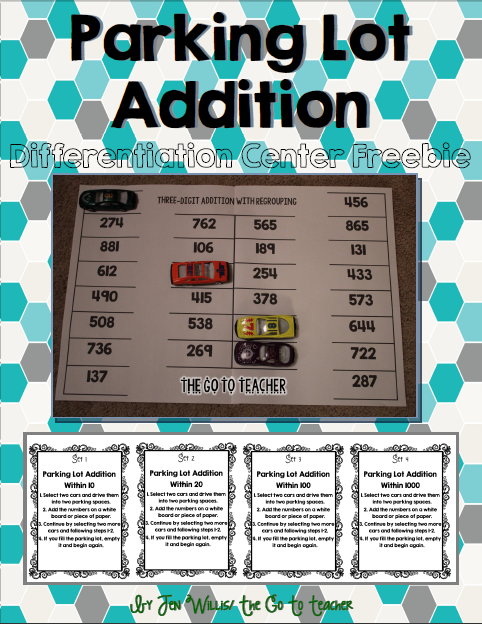
Next, is Parking Lot Addition.  My students love anything to do with cars!  I thought it would be fun for them to park the cars and add the numbers from the parking spaces.  Again, I differentiated for practice at various levels.  I think this one will be a hit!


I hope your students enjoy!


Tuesday, November 25, 2014

Merry Math

I last posted about my struggle with two-digit addition with regrouping and have had some time to think about possible solutions.

My personal go-to is reading.  I read current and relevant texts when I'm unsure of what to do next.


One of my favorite books for meeting with mathematicians in small groups is Math Exchanges by Kassia Omohundro Wedekind.  On her blog Math Exchanges, she wrote,
In my book I talk a lot about how math exchanges must be both contextually meaningful and mathematically significant. Many times “contextually meaningful” means relevant or useful to the life of the mathematician solving the problem. 
This got me thinking about giving students situations that were relevant to them.  And after Thanksgiving what else is there but TOYS?!


In the text, Learning to Love Math by Judy Willis, she shared her theory about learning from video games.  She wrote,
Video games are an example of the lure of achievable challenge because they help students reach personally desirable goals...These goals can be translated into mathematics as long as we use the model of achievable challenge (through differentiation and individualization) and connect our teaching goals with students' personal goals and interest.
This challenges me as an educator.  I have to find the achievable challenge for each student knowing that they will all be different.  For my whole group lessons, I determined that I would use the Gradual Release of Responsibility by amping up the problems each time.


Maggie Siena wrote, in her book From Reading to Math,
There is no one best way to teach math.
Confidence is paramount.
Professional development is important for teaching all students.
Everyone has the potential to understand math.
What I really honed in on in my personal quest was the idea that the student had to have confidence. Again this leads me to the GRR and teaching with Concrete, Representational and Abstract sequence.  I need to give the students in my class every opportunity to feel successful and to do this I need to create building blocks that they can stack and depend on to support them.


Here leads to my freebie!  I wanted to create materials to use the first week back that incorporated all these great things I've learned about math instruction.


Click on the link or pictures to pick up yours :)


I hope you enjoy this week and give thanks for all that you have because life is precious!!


Wednesday, August 27, 2014

Back for round 9!

I can hardly believe that this is my ninth year teaching!  Welcome back to school teachers.  I saw somewhere on the internet, There's no tired like a teacher during the first week of school tired.  SO TRUE!!

Moving from first grade to second grade this year has been a nice transition.  I know what these students learned last year and it feels like a lot less gaps to fill than in other years.  I know what they know.  It's also been really interesting to see how the Common Core standards grow with the students.  I had been a part of vertical planning before but it is just so different to do it rather than hear about it.


We jumped right in to reading and writing workshop the first day of school and it has been wonderful!

Our first unit is rooted in literature and focuses on characters and story elements.  Here are anchor charts and resources that we used to start our year.

WRITING:
This is copied (seriously word for word) from my amazing coworker's chart (L. Gilman).  The story has really helped us to break down the steps to the writing process.  *It's still a work in progress*


If you haven't heard about admiration frames before it is the best thing that ever happened to my writing instruction!!!  You can read more about in this past post: Writing realistic fiction stories.  We started admiring the author Maribeth Boelts and her book Those Shoes.  It is AH-Maz-Ing!

Then we moved on to admiring the author's sitting in our very own classroom!


When writing stories my students wrote a little and said I'm done.  I knew Knuffle Bunny was a mentor text that they had read numerous times in first grade so I pulled it out to show students how to stretch a small moment.  I created a chart like this in the past but this is a new school so I thought I could re-use it...don't tell the kids ;)

As we've been revising, I found the need to expand their writing horizons with mentor texts that we have read over the first week of school.  This was our lesson today and their new powerful endings made my heart beam!


READING:
We began with reading workshop, what it is and what it looks like.  At the bottom you will seem my very quickly created Stop! Think! and Jot! chart.

Then we moved on to wise and effective readers.

Which led us straight into our post-it thinking beautifully.  *Side note:  It is amazing starting the year with students that already know how to share their thinking on a post-it!*

And now we have moved into character responses using language stems and a good ol' rubric.  At the bottom of the chart we did an additional lesson on supporting your thinking with key details.  When looking for these key details we decided it is helpful to look at actions, dialogue, illustrations and thoughts.

Here is this sheet for you: Character Response Stem and Rubric

Here is the half-sheet that supported the students with character responses: 
 

 MATH:
Our first unit focuses on adding and subtracting within 20.  This was a standard from first grade but now the push is to do it mentally.  Here are the resources I've created to align with the standards.

Busch Gardens pre-assessment:  Before the unit, I like to pre-assess the students.  This Busch Gardens problem is from a wise co-worker from the school I worked at last year (K. Rorem).  You'll note that this pre-assessment does not have a rubric.  It is not intended for a grade, rather a way for me to gain insight into what they are already doing as a mathematician.
 

Add to 20:  This is an assessment to show understanding of adding and subtracting within 20.  At the bottom is a rubric we use to guide our learning throughout the progression of the standard and eventually assess our understanding.  The students assess themselves first and then afterwards I discuss and circle in pen where there understanding lies.
 

Odd and Even Assessment:  Next we are moving into Odd and Even.  Again this is a real-life scenario because I want math to be something the students see as useful in their day to day life.  
 

SCIENCE:
We are starting our first lab next week and here it is for you!  The materials are easy ones, just plastic bags from stores like Publix or Target :)


This is how I display the charts we are currently working on.  Afterward they move onto a subject bulletin board.


I'm just going to end this post with a good night.  I'm too tired for more!


***