Showing posts with label Guided Reading. Show all posts

Sunday, November 24, 2013

What's in your book bin?

I read a lot of books on how to teach reading.  One of the interesting topics that I always find is how to set up independent reading.  How long should it be?  What materials should the kids have access to?  How much thinking work should they be doing?  How much reading work should they be doing?  The list goes on and on.  Recently in one text I read they said that the students should have 10-12 books at their level and then half way through the week they should switch with their reading partner.  That blew me away.

Today I am going to share the items and tools in my students book bins.  They spend 25 to 30 minutes in them independently.  Then they go and meet up with their partner and read for another 15-20 minutes.

At the bottom of this page I have support materials for you that have been on my blog before but just in different posts!
Each child in my room has one of these bins (either green or blue).  

I have a rotating wheel that is labeled with special seats in the room like our stuffed horse, chairs, stools, crates, etc.  Every other day the kids get to sit in a special seat, other days it's just the floor.  

Each child has a shopping day in my classroom (Student names are on the bags for each day of the week).  They are allowed to select 5 books at their level.  Right now is our informational unit.  Unfortunately it is hard to find rich informational books at their level.  The kids are picking just right books from our class nonfiction library.

Each child has Reading Notebook.  I only have them do thinking work in it several times a week because I want them spending time reading.  The work they do is just like the mini-lesson we have done in class only in their just right text.

Support Materials: 
This is a strategy card to help them when they come to tricky words or parts.  If it doesn't make sense they look below that owl for the things they can do to solve it (Look at the pictures or Guess).  

Each child has a library card to tell their level for each month.  This helps them when book shopping.  I usually do a running record when I notice growth within a level and if they move up I write in a new level.  We also stop as a class and cheer :)

This was a Chart Chums poster that I slightly changed.  I printed one for each child to keep in their book bin to help them with Post-It thinking.

These are their small wonder books.  They write the questions they really want to know and when they find the answer they record it.

I took the Inspired Apple's anchor chart and cut it up (on the computer with the snipping tool) and rearranged it to be a bookmark.

Each child has a list of high frequency words at their reading level from Teacher's College Reading and Writing Project.  The words they can read are highlighted through and the words to work on have a dot by them.  During small groups, I occasionally assess them to see where they are at.


This is a fluency bookmark to help them give feedback to their partners.  They give one thing they did really well and one thing to work on.

The last resource is not my own.  I printed out two Chart Chums charts, tried to recreate them and made copies for each child in my class.  The kids pasted them into the front of their notebook and whenever I see them off task I say, "Look in your notebook at private reading then fix it." 

Resources for you!
Just click the picture or link to download


Guided Reading pack
This one breaks down what I do while the kids are independently reading :)


And here is my true calling according to a child in my class....a mermaid!  Wouldn't that be lovely!!  I think I might even be in charge of the sea :)  He also put my niece in the drawing...I love him!

Enjoy your day!


Friday, February 8, 2013

My inquiry into conferring

I have read a bit about conferring, I have been to some trainings, and I have tried it out in my own classroom....BUT I don't think I fully got it until I did an inquiry into it.   I wanted to know how to better utilize it in my own classroom. 

Here are the resources I used:

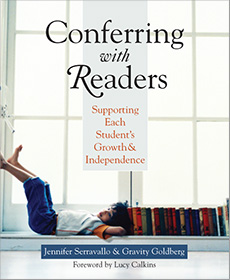
This is a great book for setting up a literature rich classroom, understanding reading workshop and beginning to confer in your classroom.  If you are reading just to find out the nitty gritty then head right to chapter 10.


A Reading Conference: Assessment-Based Responsive Teaching to Support Comprehension ( K-2 ) from TC Reading and Writing Project on Vimeo.
This video showed the steps perfectly.  Sometimes you read and read but until you see it in action you don't quite see how all the pieces fit together.


This post was so very helpful.  She shows her readers the way she codes books with teaching points and keeps them handy to pull out during conferences.


I then created a list of teaching points and created my own conferring bag.  The teaching points were based off of  Conferring for Readers,  I Do, We Do, You Do 's post about Conferring and Common Core State Standards.  You will note the standards and then my county's learning progressions to meet the standard. 
Then I used all that I learned and put it to use:
 
I started by buying a composition book and tabbing the students' names every 5 pages.
 

I decided the more simplistic my notes were the better.  I really want to practice my language and become effective.  Of course notes help us along but I didn't want to get too bogged down that I didn't leave myself enough time to actually confer.  So I write the date, the student's self selected text, the reading level of the text, the compliment (+) and areas to work on (-).  I focus on the one point and write myself a quick note of what strategy/skill I taught them.  So below I saw the child sounding out but we know that doesn't always work....so I focused on chunking sounds we know then rereading for meaning.
 
 In the front cover, I have a list of students and I will put my conferring dates next to their name.

 
I selected text from every level that I have in my classroom (C-K).  Then one lovely evening I searched through them for teaching points.  Our units are broken up by literature and informational so my books will change when we get to informational.  I also wanted strong characters and a story with a problem and solution.  

Here are the tabs for Farm Alarm
 and Biscuit Goes to School
 On this page, I have tabbed 'Punctuation.'  So I might teach one child to take breaths at certain points, another to bring their voice up at the end of the question and another to talk like the character using picture and punctuation clues.
 
So I completed my first week!  I love it <3  Now the only thing that I found difficult and probably will not follow through on is losing guided reading groups and only conferring.  My team and I discussed that our Title 1 students just do not have the schema or language needed to get by on conferring when they are at levels A-F.  Most of my class is above an F, so I am conferring with all of them but my students that are lower are still in a small group (luckily it's only one).  If you have thoughts on this point that I haven't considered please share :) 
 
Here is a little scenario that occured during a guided reading group today.  I think it shows why I can't stop guided reading for some students.
 
We were previewing Little Chimp and Baby Chimp
Me: "Tell me what you thought Little Chimp was feeling about Baby Chimp by just using the clues on the cover."
Student: He took a while and said, "Happy." 
Me:  "How do you know that?"
Student: "Reading."
Me:  "We haven't read the story yet.  I want you to use what you see on the cover to tell me why Little Chimp is happy."
Student: "Book."
Me:  "Yes, the book gives us clues.  How can you tell Little Chimp is happy?  Look at the cover (direct point to Little Chimp)."
Student: Uhhhh. (shrugs shoulders)
Me:  "I want you to think about what you do when you are happy."
Student: (slowly smiles)
Me:  "You are showing me you are happy with your face.  How are you doing that?"
Student:  "Mouth."
Me:  "Yes, you are using your mouth.  What is your mouth doing?"
Student:  (student shrugs)
Me:  "You are smiling to show you are happy.  Look at Little Chimp, he is smiling to show he is happy."
 
Enjoy your weekend fellow bloggers and blogees!


Friday, June 15, 2012

Guided Reading or Bust!

Guided reading is a hard one....there is just so much to it and the students vary so greatly within the class and from year to year. 

The guided reading pack where I outlined where to begin and where to go has been popular because it takes it step by step in a simple way:  Guided Reading pack
Now get organized even further with this new 8 page pack @ my TPT store!


Monday, March 5, 2012

Laughing through Monday

My kids were the cutest things ever today!  They had me laughing out loud today on several occasions. 

One little firstie wrote in his How To book on how to get dressed for soccer, Put on your shirt so you don't show off your pecks!  Where do they get it?  Just love them to pieces!!

So I wanted to show you what I do once I collect all my information from a running record.  In this case it is DRA which is a bit more comprehensive but I still use the Miscue Analysis sheet to help guide me with my decisions for each child.

Here is a link to it in case you need it: Miscue Analysis

After the running record, I spend a very lovely evening (that's a stretch) review the running records and noticing what each child is doing.  I look at what they are successfully using and what I need to support them with.  Then I create a document that holds my whole class.  It tells what level they are at, their accuracy, comprehension, words per minute read, what group they are in, what goals I have set to teach and support them with, and what intervention they go to.  My school has two separate intervention times because we have a Tier problem, meaning too many meet the criteria :( 

This is what it looks like (note the codes on the 3rd page):


It's very helpful when planning my guided reading groups.  While in the groups, I can hit on something with one child or I can do a quick lesson for them all.  I also attack my goals during my conferring time while they are working in partnerships. 

Here is a blank form for you to work from: DRA Information blank (I have also given access to edit this form).


Goals (you may need more or less for your class depending on your needs):

Word work: when a child is not using their visual information (Does it look right?) we start noticing patterns within words, deleting/substituting phonemes, etc.

Strategies: Does it make sense? Does it sound right? Does it look right? if not, what do you do next?

Monitor for Meaning: A child that is only using their visual information (chunking words, sounding it out) and not thinking about the story

Vocabulary: when a child comes to words that they have never heard of it is time to attack oral language while integrating vocabulary

Comprehension: when a child needs support with retelling, predictions, connections

Fluency: the reader is choppy or rereads so frequently that you lose sight of the story

Blending: this is for my lowest students, just practicing the basics


Hope you see that a little time helps a lot with preparation!  Let me know if you have any questions.


Tuesday, February 28, 2012

March Madness

March Madness has something to do with basketball, right??  It makes me think of the countdown till spring break and how quickly the days pass after it.  I told someone today that being in my class was like heaven on earth.  They are so wonderful, I can't even think about June when they will leave me for grander horizons.  I need it all to slow down!


Saw this wonderful idea on Pinterest and knew I had to use it: 
Pinned Image
I couldn't find the original person that uploaded it but kudos to whoever you are :)

Mine is a bit simple but you could print it on colored paper. We are starting to select our goals during conferences tomorrow!  Get yours below :)


Writing Goals, Traits


I've been working on a guided reading instruction pack.  It came about when I was trying to share it all with my intern.  It's hard model and talk about all the ins and outs.  We all know that it is overwhelming to begin and follow through with!

The pack I created has a checklist of materials needed, helpful hints about grouping students, a chart to schedule time for each group, running record forms, ways to analyze a running record, daily note page for each group, record log for individuals, and a format to follow when working with students. It's far from perfect but a quick and dirty overview to get started.


Here are pictures from my classroom that explain my set up:
These are my guided reading books. All the copies are in one bag and filed under their level.  You will notice I wrote various levels on the books because it seems that everything differs.  My school uses the Guided Reading levels develop by Fountas and Pinnell. 
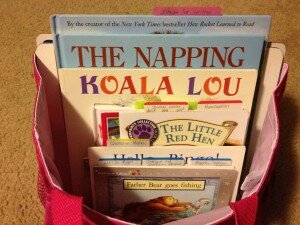
 The baskets are leveled.  Each level has around six different text selections.  The books have the level listed on the back.  This set is PM Rigby.

In case your school doesn't have the funds for a different series of guided reading books you can always level your readers that go along with your basal.  Most of the time they aren't used in a leveled order, they are based of comprehension or phonics strategies.  Leveling them helps your readers because it puts just right books in their hands.  


Here is my binder:
 I have a schedule in the front and a list of needs for each group.  Currently I am working with 2 groups a day and my intern is working with 1 a day.  So you may notice I only have 3 groups listed, she is in charge of the other 2 groups;)
 This is my note taking page.  It defintely helps with planning effective lessons.
 Goals for the following week based of noticings.
 Leveling guide in front pocket developed for our school's needs.
 Running Record cues in the back pocket.


 Bins for each group with books to reread and new reads, writing journal for each child and a couple other things based off the needs of the group {2 bins are stashed behind}.

 Whiteboards, fluency rubric, easy button and bell for clean up warning.

Back of easel that is used for word work.

Large book covers make great seat sacks for whisper phones because each kid is reading at their own pace.

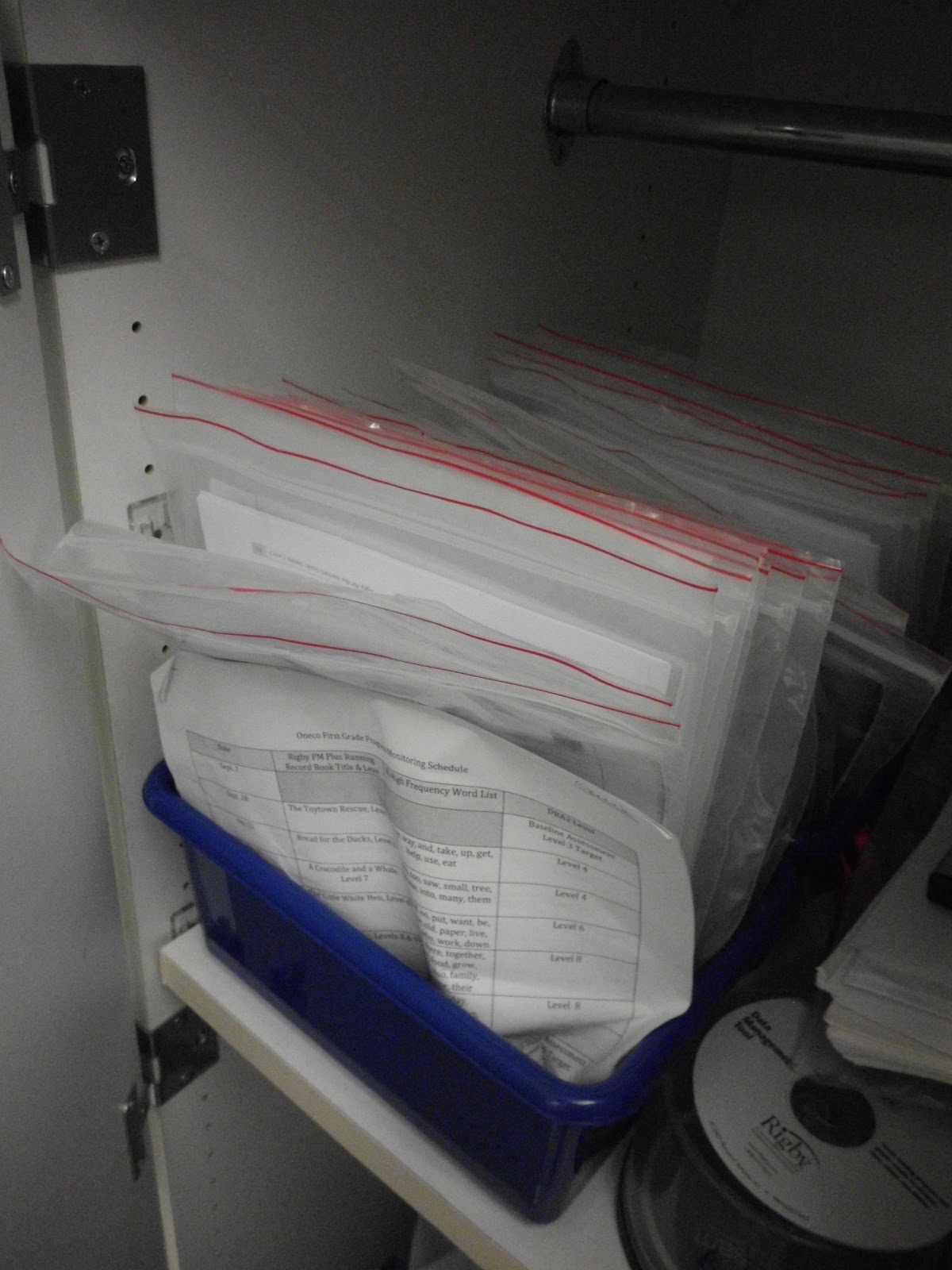
Running records organized by level.
 What the individual bags look like...several copies of the running record and one book.

Check out these links for helpful guided reading resources:
Developmental DRA chart tells where your kids should be and when
Fountas & Pinnell Text Level Descriptions  <-----so helpful! tells what students do at each reading level

Enjoy!


***